1. Tricky situations:
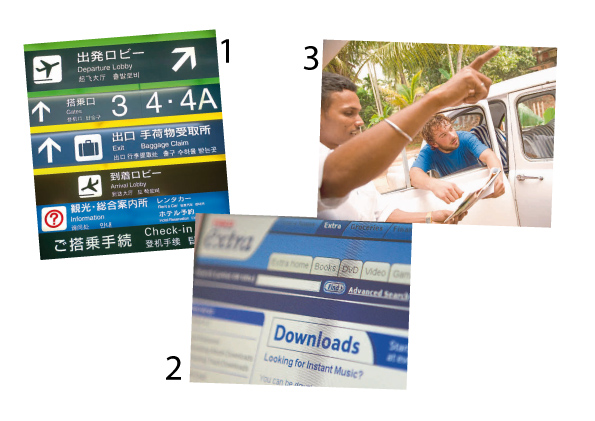
- Take a look at these photos – describe the situation in one English sentence (Who? What? Where? Why?) and use the Present Progressive when you describe an action that is going on!
- What can help you a lot in situations like these?
- These are maybe signs at an airport. They are in Chinese, but there is an English translation, too. So English can help you in this situation
- This photo shows a website where you can download music. Everything on this website is in English, so English can help you if you want to download something, for example.
- A man is sitting in a car and holding a map in his hand. The other man is showing the man in the car something on the map. Maybe the man in the car is a tourist and needs information. In this situation English can help you, too!
- Yes, English can help you in a lot of situations … but do you know how many people all around the world (= auf der ganzen Welt) speak English? And where do people speak kinds of (= Arten von) English? Let’s find out!
2. English-speaking countries
- Try and answer the questions of exercises 1a and 1b on page 102 in your textbooks:
- Canda, USA, Ireland, United Kingdom, Bahamas, Guayana, Nigeria, Sudan, Australia, New Zealand (and many other countries)
- computer, toast, hamburger/cheeseburger, snack, cool, comic, event etc …
- Nearly 2/3 of the people on Earth speak one of these 12 languages (= Sprachen). But which languages are the top give? Do this test!
- OK, so English is not no. 1, but people use it all over the world everyday: in business, on the internet, in universities and school etc.
- Let’s do exercise 1b on page 102 next: use the phrases in the green box on the right and form four or five sentences.
- We often speak English on holiday, when we are in a hotel or at the beach and speak to tourists from other countries
- Sometimes we speak English when we talk to friends from another country on video chat or on the phone
- Some German speak English at work because some of their colleagues do not speak German
- Sometimes we speak English in town when a tourist asks us something
3. A film - speaking English:
- Watch this short film and take notes – what does it show you about English in different countries?
- The film shows that the people speak different kinds of English in different countries
- The British and the Americans sometimes use different words
- English also helps people from two different countries to talk to each other!
- Yes, he does – he speaks about the USA, Australia, New Zealand, Canada and Ireland, for example
- Watch the film again and say which of the sentences of exercise 2d are right. Correct the wrong sentences!
- wrong – he is on holiday
- right
- right
- wrong – he can show her where the supermarket is
4. Homework:
- Learn the new words of Focus 2 and write them into your vocabulary book
- Page 102/2e : write down a short dialogue for one of the two situations and use words from the box on the right. Write 6-8 sentences into your homework book!
5. Learning languages:
- Yes, learning languages is easy – but only if you are in the right class and learn the right language, not like in this video!